
Understanding Lubbock County Releases
A release from the Lubbock County Detention Center means that the Sheriff no longer holds the person under that booking. It does not always mean the person went home. Bond, a court order, time served, sentence completion, dismissal, or acquittal may lead to community release. The same jail exit can instead be a transfer to the Texas Department of Criminal Justice, another county, the U.S. Marshals Service, or immigration custody. The release code and destination in the jail record matter more than a missing name.
State-prison terms use different words. Parole and mandatory supervision permit physical release while TDCJ supervision continues. Discharge means the sentence has ended. A projected date is only a calculation, and a scheduled date can still change. Probation, called community supervision in Texas law, comes from a court order and is handled by the local supervision department. These distinctions determine which office can confirm the next status.
- Bond
- Release from jail while the criminal case remains pending, subject to the bond and court conditions.
- Time served
- Release after the credited jail term has been satisfied.
- Parole
- Conditional release from state prison while the sentence continues under supervision.
- Discharge
- Completion of the sentence, distinct from transfer or supervised release.
Lubbock County Release Paths
Each Lubbock County release path leaves a different paper trail. A bond or local court order should appear in the county criminal case. A county sentence should tie to the judgment and Sheriff’s time calculation. A state-prison transfer moves the inquiry to TDCJ. When a hold belongs to another authority, the county record should identify the receiving agency if that field is maintained and releasable.
| Release path | Meaning | Best next record |
|---|---|---|
| Bond or personal bond | County jail custody ends while the charge remains open. | Bond entry and court order |
| Dismissal, acquittal, or court order | The court directs release or resolves the charge. | Signed order or judgment |
| Time served or sentence complete | A local jail term and credited time have been satisfied. | Judgment and release record |
| TDCJ transfer | County custody ends, but state-prison custody begins. | TDCJ inmate information |
| Other agency or detainer | Another county, federal agency, or ICE may take custody. | Destination field and receiving-agency record |
Death or a medical movement can also remove a name from a roster without a normal community release. Never translate an unexplained local code. Request the code definition and the destination or receiving authority.
When Lubbock Bond Release Starts
Lubbock County Sheriff information says initial appearances occur at least twice each day and sometimes more. The Active Jail Search describes livestreamed appearances up to three times daily as needed. After the magistrate sets bond, the active roster updates the bond information. Full bond may be paid at the Detention Center Bond Window or arranged through a surety. These steps explain how a bond release can begin, but they do not create a published list of everyone released within a day.
The county Fair Defense Plan adds a narrow timing rule for warrantless arrests. It addresses probable-cause determinations within 24 hours for a misdemeanor and 48 hours for a felony, with stated bond or personal-recognizance procedures when those limits are not met. This is a due-process process, not proof that every arrested person must leave within either period. Bond release ends jail custody while the case stays pending.
Lubbock County Release Record Fields
Ask for an existing booking and release record, jail card, or equivalent record tied to one booking event. A name alone can match the wrong person. A booking number, cause number, date of birth, SID number, or date range narrows the request. Some fields may be withheld or redacted, but the Sheriff can release the nonexempt portion when the record is otherwise public.
| Field | What it shows |
|---|---|
| Booked name and aliases | The identity used for the custody event |
| Booking number and date | The unique jail event and when it began |
| Arresting agency, charge, and cause number | Which authority and court file connect to custody |
| Bond type and amount | The release terms set while the case is pending |
| Detainers or holds | Whether another authority may claim custody |
| Release date and time | When the Detention Center relinquished custody |
| Release type or code | The recorded basis for the jail exit |
| Destination or transfer agency | Whether the person went to the community or another custodian |
| Property acknowledgment and photograph | Related releasable booking materials, if maintained |
No official Lubbock source promises that a released booking remains online for a fixed period. The live roster is not a retention schedule. The formal jail record and court file are the durable sources, subject to retention rules and any sealing, nondisclosure, expunction, juvenile, privacy, or active-case limit.
Request Lubbock County Release Records
The Sheriff’s LSO-1064 Request of Information form expressly lists Booking/Intake Records, Jail Logs, Movement/Transport Records, and Release / Transfer Documentation. This is the strongest local route when the roster no longer shows the person. Describe an existing record instead of asking staff to research a question or create a report.
- Give the full name, date of birth, booking or SID number, cause number, and a narrow date range when known.
- Request the jail card, release date and time, release type or code, releasing authority, destination or transfer agency, and any releasable booking photograph.
- Send the request by email to LCDCRecords@LubbockCounty.gov, fax to (806) 775-7991, mail to P.O. Box 10536, Lubbock, TX 79408, or deliver it at 712 Broadway.
- Ask for electronic copies, an itemized estimate before chargeable work, code definitions, and redaction with release of the remainder.
712 Broadway
Lubbock, TX
Email: LCDCRecords@LubbockCounty.gov
Fax: (806) 775-7991
Texas Government Code §552.221 calls for prompt production. Under §552.301, an office that seeks an attorney-general ruling to withhold requested information generally has ten business days to request that ruling. That deadline is not a promise of record delivery in ten days. A focused request can reduce both delay and cost.
Lubbock County Record Access Limits
The Texas Public Information Act presumes access to government records but includes specific exceptions. Law-enforcement interests, privacy, confidential criminal-history material, juvenile law, security information, and court orders can limit part of a jail file. A requester can ask the agency to redact protected material and produce the rest.
Leaving custody does not erase the booking. Texas expunction under Code of Criminal Procedure Chapter 55 and an order of nondisclosure under Chapter 55A are separate, case-specific remedies. A dismissal does not guarantee eligibility. A court order can change later public access, yet an old roster capture should never be treated as current proof. The signed expunction or nondisclosure order and the court that issued it control the result.
Can a release entry be corrected? If the Sheriff’s entry appears wrong, Logistics/Auditing can help route the issue because it receives legal documents and updates inmate records. Still obtain the written release record and the signed court document. Texas Business and Commerce Code Chapter 109 governs certain publishing businesses, not deletion of a lawful Sheriff record on demand.
Lubbock Release Records Split by Court
Lubbock divides criminal records by court level. The County Clerk criminal division handles misdemeanor county-court-at-law cases, while the District Clerk handles felony district-court cases. The County Clerk states that staff do not search by name to determine whether a misdemeanor case exists. Carry the cause number from the jail record into the clerk request.
The County Clerk lists copies at $1 per page plus $5 for certification, with cost confirmed by phone using the case number and name. District court records use a different office. Search docket entries for bond, dismissal, judgment, sentence, jail-time credit, community supervision, revocation, acquittal, or appeal, then obtain the signed order when a short docket label is unclear.
The successful official images below show both local court routes. The County Clerk source leads to misdemeanor record access.

That page supports a cause-number-based copy request. The District Clerk source is the felony path.

Together, the two offices help explain why county custody ended, but the signed order carries more weight than a brief online docket entry.
Find Released Lubbock County Inmates
The search must follow the custody path. Begin with the county system for a local booking, then move to the court and any receiving agency. A missing name is a clue, not a finding. Preserve the date searched and the exact words each system uses.
- Check the official Lubbock County roster to see whether the person is still in county custody.
- If absent, request the Sheriff’s release or transfer documentation and search Texas IVSS-Counties for a custody event.
- Use the charge and cause number in the misdemeanor or felony court file to locate a bond order, dismissal, judgment, or release order.
- If transfer to state prison is possible, check TDCJ and request state release or discharge information when the online current-inmate search fails.
- For a federal or immigration matter, use the BOP locator, federal docket, or ICE custody channels as appropriate.
The official Lubbock County roster gateway labels the information real time and offers interactive, PDF, and Excel formats.

All three formats cover the same current-custody data. None is a separate release archive.
Lubbock TDCJ Release Search
The TDCJ offender search covers people currently incarcerated in a TDCJ facility. Search by TDCJ or SID number for the best match, or use the name and available demographic filters. A current detail can show the unit, offense, projected date, maximum date, and parole-review information. Data are updated on working days and may be at least 24 hours old.
| Search or detail field | Use |
|---|---|
| TDCJ number or SID | Most precise identity match |
| Last and first name | Broader search when an ID is unknown |
| Gender and race | Filters to separate similar names |
| Current unit or status | Shows present TDCJ placement |
| Projected release date | Conditional date calculated by Classification and Records |
| Maximum sentence date | Sentence endpoint shown by TDCJ |
| Parole review information | Review stage or decision-related information |
The official search image shows the fields used for a Lubbock County state-prison check.
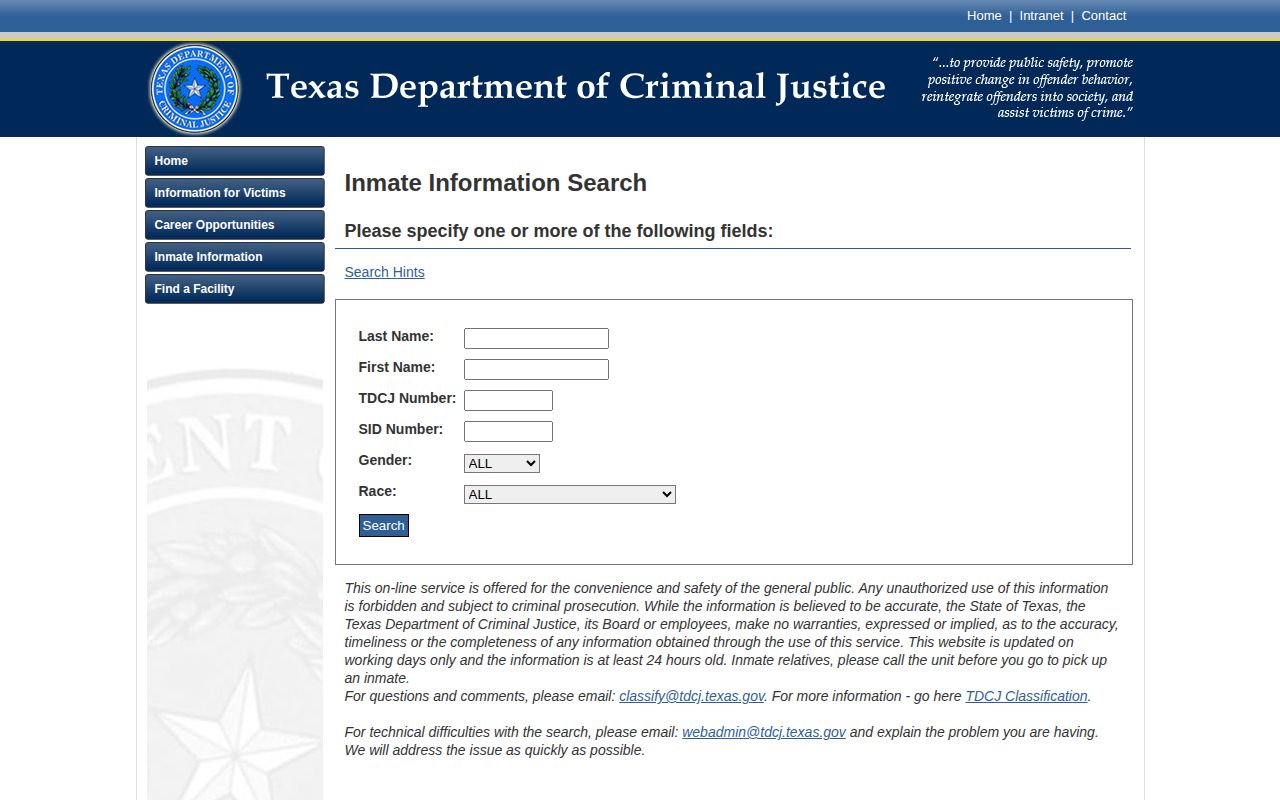
A former prisoner may not appear because this is not a released-person archive. TDCJ’s no-charge email and telephone routes, a Public Information Act request, Parole Division, and the sentencing court are the proper fallbacks.
Montford Release or Medical Transfer
John Montford Unit is a TDCJ prison, not a county jail. TDCJ describes extensive regional medical, psychiatric, geriatric, dialysis, surgical, and long-term-care functions. Its components opened between 1994 and 1996. A person may leave Montford to continue custody at another TDCJ unit after treatment or a change in placement.
Disappearance from a Montford-specific setting must not be called community release. Check the statewide TDCJ detail for the current unit, projected or scheduled date, maximum date, parole information, or discharge. Review and Release Processing can confirm a sufficiently advanced scheduled release. Parole Division becomes the proper channel after parole or mandatory supervision starts. The county roster has no role in confirming a Montford discharge.
Lubbock Release Alerts and Federal Records
Texas county notifications moved from VINE to Texas IVSS-Counties on September 1, 2025. Existing registrations carried over. The portal accepts full or partial name, DOC ID, SID, Jail ID, or permanent booking number and can provide selected booked/released, court, death, escape, or TDCJ-transfer events by phone, text, or email. It may omit people no longer in custody, so a saved notice plus Sheriff documentation is stronger than a later search miss.
For federal prison, the BOP Inmate Locator may show “Released” and a date. “Not in BOP custody” is broader and can mean USMS pretrial detention, state custody, transfer, or no BOP commitment. The Northern District of Texas docket can hold the release order, judgment, revocation, or dismissal. ICE’s locator is mainly for current immigration custody, and a miss cannot prove release. No current ICE detention facility in Lubbock County was verified.
The successful BOP source image illustrates the federal lookup route.
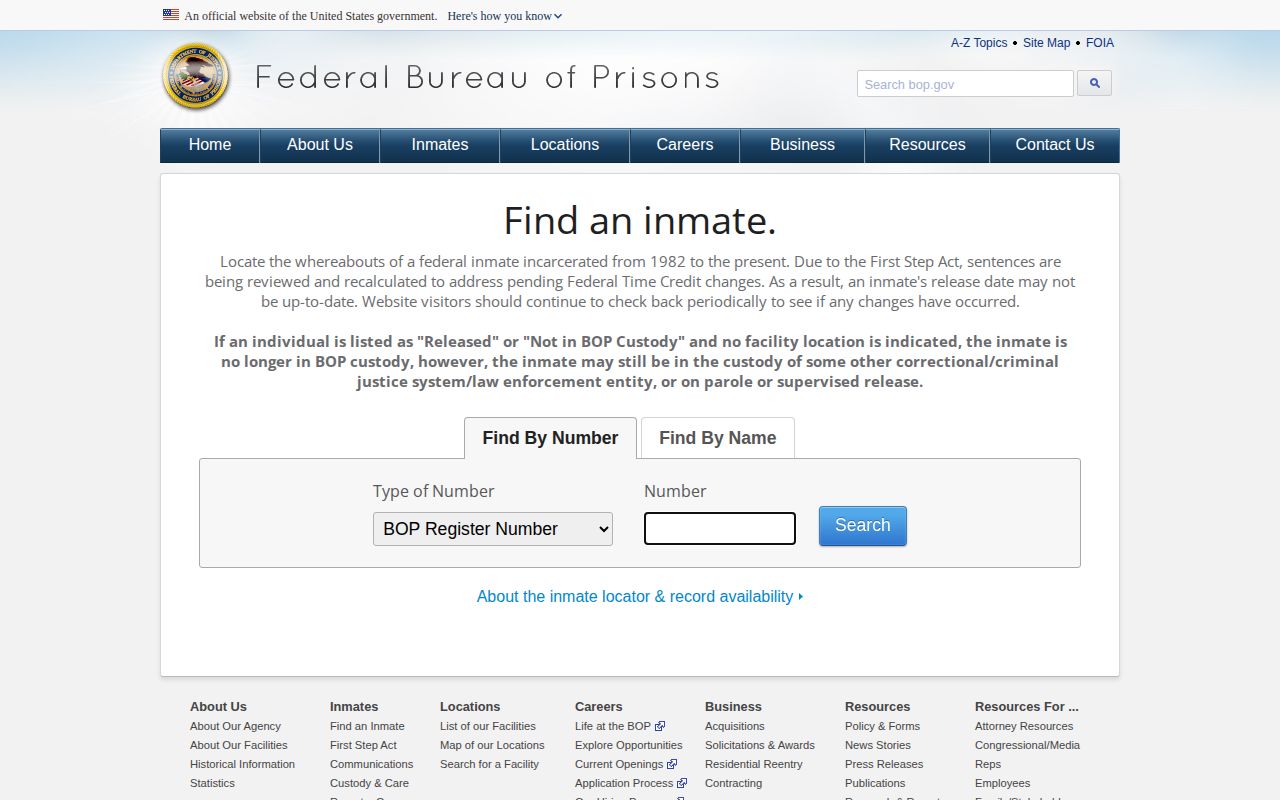
Federal identity and docket records should confirm any released result, especially when a local jail booking involved a federal hold.
Where Lubbock Release Status Appears
No single portal covers every Lubbock County release. Match the tool to the custodian and the stage of the case. The table separates current-custody checks from records that can prove a past event.
| System | What it covers | Meaning of a miss |
|---|---|---|
| Lubbock jail roster | Current county jail custody | Could be release, transfer, delay, or mismatch |
| Sheriff release record | Past county booking exit, code, and destination | Refine identifiers or request scope |
| County or District Clerk | Legal disposition, bond, sentence, and orders | Use the correct court and cause number |
| TDCJ search | Current state-prison custody and future-date fields | Former prisoners require agency or court records |
| IVSS-Counties | County custody and notification events | People no longer held may be omitted |
| BOP locator | Federal prison custody and many former prisoners | Check USMS and the federal docket |
| ICE locator | Mainly current immigration detention | Contact ERO or use immigration records |
Two independent official records provide the best confirmation. Examples include a jail release timestamp plus a signed court order, or a TDCJ release record plus a Parole Division assignment. Search misses and roster absence rank below those documents.
Lubbock Supervision After Release
Parole and mandatory supervision follow a TDCJ prison release. The TDCJ Parole Division handles those cases, and the Texas Board of Pardons and Paroles makes release decisions. Lubbock-Crosby County Community Supervision and Corrections handles probation ordered by a local court. There is no statewide public locator for an individual on Texas probation.
Use the TDCJ details and Board status channels first for a state-prison case, then the Lubbock District Parole Office directory. Use the signed court order and local supervision office for probation. Federal supervised release belongs to the federal court and probation system. Additional local verification routes are documented through Probation & Parole.
Lubbock County Release Facilities
Two adult facilities in Lubbock County serve different custody systems. The Lubbock County Detention Center is the Sheriff-operated county jail for local arrest, pretrial custody, short sentences, warrants, and some holds. Community release or transfer is confirmed through its booking and release record, the court file, and any receiving agency.
John Montford Unit is a state prison operated by TDCJ. A person may discharge, start parole or mandatory supervision, or transfer within TDCJ. Its release path is verified through statewide TDCJ records, not the county jail roster. Juvenile detention is excluded because juvenile records have different confidentiality rules and should not be treated as adult released-inmate records.
Note: no current official source established an active federal prison or designated ICE detention facility within Lubbock County.
Public Record Search
Sponsored Results