
Lubbock Projected and Actual Release
Texas uses several date labels, and each marks a different stage. TDCJ defines a Projected Release Date as the date calculated by its Classification and Records Office when a prisoner may leave incarceration if parole does not occur sooner. A Scheduled Release Date can appear after approval, certificate, and audit work progresses. The actual release date records the event that occurred. None of these should be exchanged for another.
A pretrial detainee at the Lubbock County Detention Center has no sentence-based projected date. Custody may end through bond, a court order, dismissal, transfer, or later sentence action. A county-sentenced person has a local calculation. A TDCJ prisoner, including someone at John Montford Unit, has a statewide calculation. The first task is therefore to identify the custodian and legal status.
Find Lubbock County Projected Release
For a current state prisoner, the TDCJ offender search is the public starting point. A TDCJ number or SID gives the most precise match. Name and demographic fields can be used when an identifier is not known. Open the correct detail and preserve the label beside each date. The online tool is expressly limited to current inmates, so it will not serve as a lasting discharged-person archive.
- Decide whether the person is pretrial, county-sentenced, or in TDCJ custody.
- For TDCJ, search by TDCJ or SID number and verify the person’s details.
- Record the exact Projected, Scheduled, maximum-expiration, or review label shown.
- For county custody, obtain the judgment and ask Sheriff records for the computation or release entry.
- Recheck with the custodian before relying on a date that may have changed.
The Lubbock County release record path is the right fallback when the person no longer appears online. TDCJ also accepts inmate-information requests by email at pia@tdcj.texas.gov. Include the full name and seven-digit TDCJ number. If the number is unknown, provide the exact birth date or approximate age and county of conviction. TDCJ says that service is free.
Two Lubbock Release Clocks
Lubbock County has two fundamentally different sentence clocks. A jail-only sentence is governed by the court judgment, jail-time credit, and the Sheriff’s lawful computation. TDCJ’s Projected Release Date does not calculate a term served only in the county jail. Ask for the commitment or judgment and the existing sentence-computation or release record. No official local source establishes a public county calculator or a special weekend or holiday early-release rule.
John Montford Unit is a TDCJ prison and medical or psychiatric unit, not a county jail. A person leaving Montford may transfer to another TDCJ unit for continued custody. A missing Montford location therefore does not show community release. TDCJ inmate information, Review and Release Processing, and Parole Division supply the correct state path.
| Person’s status | Date source | Key limit |
|---|---|---|
| Pretrial county detainee | Court and Sheriff custody record | No fixed sentence date |
| County jail sentence | Judgment, jail credit, Sheriff computation | Not calculated by TDCJ |
| Current TDCJ prisoner | TDCJ detail record | Projection may change |
| Former TDCJ prisoner | TDCJ information request and discharge record | Online locator is current-inmate-only |
Texas Good Time and Release
Good-conduct time is often misunderstood. Texas Government Code Chapter 498 authorizes classification and credits, but Section 498.003 states that good-conduct time affects eligibility for parole or mandatory supervision and does not otherwise reduce the sentence term. Credits are privileges, can depend on classification, and may be forfeited. They should never be subtracted from a sentence to make a home calculation.
Government Code Chapter 508 controls release eligibility. Section 508.145 applies different formulas to different offense and sentence categories. Section 508.149 identifies exclusions from mandatory supervision and the discretionary review that applies to eligible modern cases. Offense date, offense nature, sentence, flat time, good time where allowed, Board action, and other sentence facts all affect TDCJ’s result.
Texas has no blanket adult-prison rule requiring everyone to serve 85 percent. Certain serious offenses and affirmative findings linked to Article 42A.054 require a flat-time threshold for which good time does not advance the minimum. Other categories use different provisions. Eligibility only creates review eligibility. It does not promise approval or set the release gate time.
The project’s successful image of Texas good-conduct time law shows the source used for this distinction.
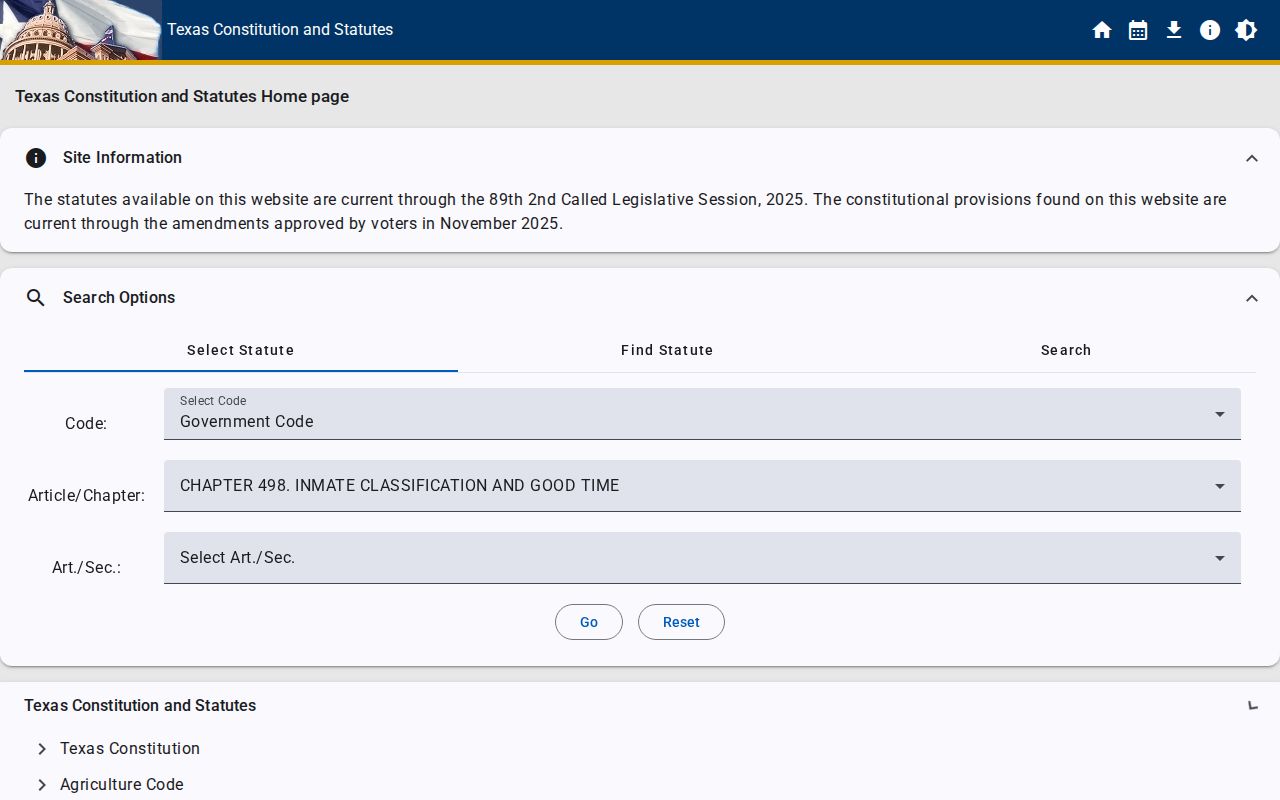
The statute explains why good time belongs in an eligibility analysis, not a simple sentence subtraction.
Lubbock Jail Good Conduct Credit
County jail credit has a separate legal basis. Texas Code of Criminal Procedure Article 42.032 permits, but does not require, a sheriff to grant commutation for good conduct, industry, and obedience. The statute permits a maximum deduction of one day for each day actually served and allows forfeiture after sustained misconduct. The Sheriff keeps the conduct and calendar record.
That authority is not TDCJ good time. It is also not the same as pretrial bond release. A Lubbock County estimate must begin with the signed judgment, the amount of jail-time credit, and the Sheriff’s actual computation. If the public record does not show the arithmetic, request the existing computation rather than asking staff to create a forecast. A later court order or another custody hold can still affect when the person physically leaves.
Note: No verified Lubbock source publishes a local credit table, public calculator, or fixed weekend release adjustment.
Why Lubbock Release Dates Change
A projected date is a calculated status at a point in time. New sentence data, disciplinary action, Board decisions, legal holds, and release processing can alter it. Even a favorable parole vote may carry conditions or a required program before release. A transfer between TDCJ units changes location without ending incarceration.
| Factor | Possible effect |
|---|---|
| Good-time forfeiture or class change | Changes eligible credit used in the state calculation. |
| Parole approval | May permit earlier conditional release after prerequisites are complete. |
| Parole denial | Produces a next-review path and may leave a later date controlling. |
| Mandatory-supervision review | Approval or denial can alter the projected path for an eligible case. |
| Court order or corrected sentence data | Can revise the legal term or credited time. |
| Detainer or receiving authority | May shift the person to another custodian rather than the community. |
| Certificate or audit processing | Can move a scheduled date before final release. |
An ICE detainer or warrant from another jurisdiction is especially easy to misread. Local or state custody may end while another authority takes custody. The county or TDCJ release entry should identify the receiving authority when that information is releasable.
Lubbock Parole Dates Need Context
Parole is conditional release from prison while the person serves the remaining sentence under supervision. Mandatory supervision also continues state legal custody in the community. Neither means the sentence has ended. The Texas Board of Pardons and Paroles makes release decisions, while TDCJ Parole Division handles supervision and release processing.
Ordinary Texas review is a file-vote process, not a public hearing calendar. A three-member panel votes, and two matching votes decide the result. Approval codes can call for release when eligible, a future month, or completion of a program. A denial can set a later review. Those vote codes are not physical release timestamps. After a favorable vote, Review and Release Processing handles certificate and status work.
- Projected release
- A calculated possible date based on current sentence and eligibility data.
- Scheduled release
- A later processing date that still may change.
- Parole
- Conditional community release while the sentence continues under state supervision.
- Discharge
- The formal end of the sentence or supervision obligation.
- Detainer
- A request or notice that another authority may take custody.
Confirm Lubbock County Release
For county custody, request release or transfer documentation from LCSO using the LSO-1064 form. Give the person’s name, birth date, booking or SID number, case number, and date range. Ask for release date and time, release type, authority, destination, booking identifier, and any existing computation record.
For TDCJ, compare the current detail with agency information and the court judgment. The Lubbock County IVSS notification process can send an event alert, but IVSS is not the final release record. TDCJ’s release-status line and Parole Division can clarify the processing stage. A former prisoner who has dropped out of the current-only search requires the email, telephone, formal records, or court route.
Strong confirmation joins two official sources. A TDCJ date plus a discharge certificate, or a Sheriff timestamp plus a signed court order, is more reliable than a roster disappearance. Record the search date because projections and custody status change.
Record Lubbock Release Date Fields
Preserve each date with its label and source. A useful note includes the person’s exact name, TDCJ or SID number, booking number where applicable, offense and county, current unit or facility, projected date, scheduled date, maximum-expiration date, parole-review status, and the time the record was checked. Qualifiers matter. A blank field is not the same as a zero sentence, denial, discharge, or immediate release.
When the date later changes, request the existing agency record that explains the new calculation or status. The public office need not create a custom legal analysis, but it can identify and release nonexempt records already held. For a county sentence, the judgment and Sheriff computation are central. For a state sentence, use TDCJ and the sentencing court. This keeps the two Lubbock clocks separate and avoids turning an estimate into a promise.