
Lubbock Parole and Probation
Parole is conditional release from a TDCJ prison before the sentence fully ends. The Texas Board of Pardons and Paroles makes the release decision, and the TDCJ Parole Division supervises the person in the community. Mandatory supervision is another form of supervised prison release. Neither means the sentence has been discharged. Probation is a sentence or court disposition administered as community supervision. A Lubbock court places the person under the Lubbock-Crosby County Community Supervision and Corrections Department, or CSCD.
The source of authority matters more than the person’s address. A person living in Lubbock may report to a state parole office, a local CSCD office, or a federal probation officer. Each keeps a different file. The Lubbock County jail roster only reports active county custody, so it cannot identify the correct supervision branch after release.
| Record | Authority | How to confirm |
|---|---|---|
| Parole | Board and TDCJ Parole Division | TDCJ identifiers and district office |
| Mandatory supervision | TDCJ and Board | TDCJ release data and Parole Division |
| Probation | Sentencing court and CSCD | Signed order and local CSCD |
| Federal supervision | Federal court | Federal docket and probation system |
Verify Lubbock Post-Release Supervision
Begin with a reliable identifier. A seven-digit TDCJ number or SID sharply narrows a parole inquiry. For probation, use the cause number and the court that signed the order. Names alone can match several people, and a roster miss proves only that the person was not found in that current dataset.
- Determine whether the case produced a county court order, TDCJ prison term, or federal sentence.
- For state prison, search TDCJ inmate information and note the number, release language, and parole data.
- Use the Parole Division directory to locate the assigned office.
- For court-ordered community supervision, obtain the judgment and contact Lubbock-Crosby CSCD.
- When status remains unclear, request the agency’s existing record.
TDCJ accepts inmate-information questions by email with the full name and TDCJ number. If that number is unknown, provide exact birth date or approximate age and county of conviction. The online search focuses on current inmates, so a former prisoner may require email, telephone, Parole Division, or a formal records request.
Lubbock Parole Office Records
The Lubbock District Parole Office is a TDCJ Region V office. It routes questions about state parole or mandatory supervision. It does not administer probation imposed by a Lubbock court.
1720 East Regis Street
Lubbock, TX 79403
(806) 747-8282
Fax: (806) 747-8407
Before a Board vote, use (844) 512-0461. After a favorable vote, Review and Release Processing status is at (512) 406-5202. General inmate information numbers are (936) 295-6371 and (800) 535-0283, weekdays from 8:00 a.m. to 5:00 p.m. Approval is not the physical release date because audits, certificates, programs, and scheduling may remain.
Lubbock Parole Status Changes
Conditions come from the release certificate or court order. They may govern reporting, travel, programs, residence, or other case-specific duties. Only the controlling document and supervising officer establish one person’s terms. An alleged violation can lead to new instructions, a warrant, revocation proceedings, or custody. “Absconder” describes alleged noncompliance; it should not be recast as guilt of a new offense.
Texas IVSS-Counties may provide selected custody and supervision notifications. Its search can omit people no longer in custody, so an absent result is not a discharge record. The signed order or agency record is stronger.
Lubbock Supervision Discharge Records
Supervision ends through the authority that imposed or administered it. A parole or mandatory-supervision discharge belongs in TDCJ records. A probation discharge or early termination rests on a signed Lubbock court order. Physical release from prison or jail is not the same event. Someone can live in the community while still under legal supervision.
Request the discharge certificate, agency letter, or signed order. Texas DPS registry guidance identifies those forms as useful proof in its limited registry context. The broader Lubbock County released-inmate search explains how they fit with jail and court records.
Lubbock Probation Office Records
Lubbock-Crosby County CSCD supervises adults placed on community supervision by local courts. Its office is at 701 Main Street, and its number is (806) 775-1200. Hours are Monday and Thursday, 7:00 a.m. to 6:00 p.m., and Tuesday, Wednesday, and Friday, 8:00 a.m. to 5:00 p.m.
There is no statewide public locator for individual Texas probation cases. TDCJ’s Community Justice Assistance Division sets standards and funds programs but does not work directly with individual supervisees. Start with the Lubbock judgment, cause number, and CSCD. That chain shows whether probation was ordered, changed, revoked, or discharged.
Three Lubbock Supervision Systems
Lubbock residents can encounter local probation, state parole, or federal supervised release. This local distinction is easy to miss because all operate after confinement. The agency directory and court order identify the right one, not the jail roster.
A felony judgment sending someone to Montford or another TDCJ unit points toward state records. A county judgment imposing community supervision points to CSCD. A federal judgment from the Northern District of Texas points to the federal docket. The wrong office may truthfully report no record while another system holds it.
Lubbock Parole Review Records
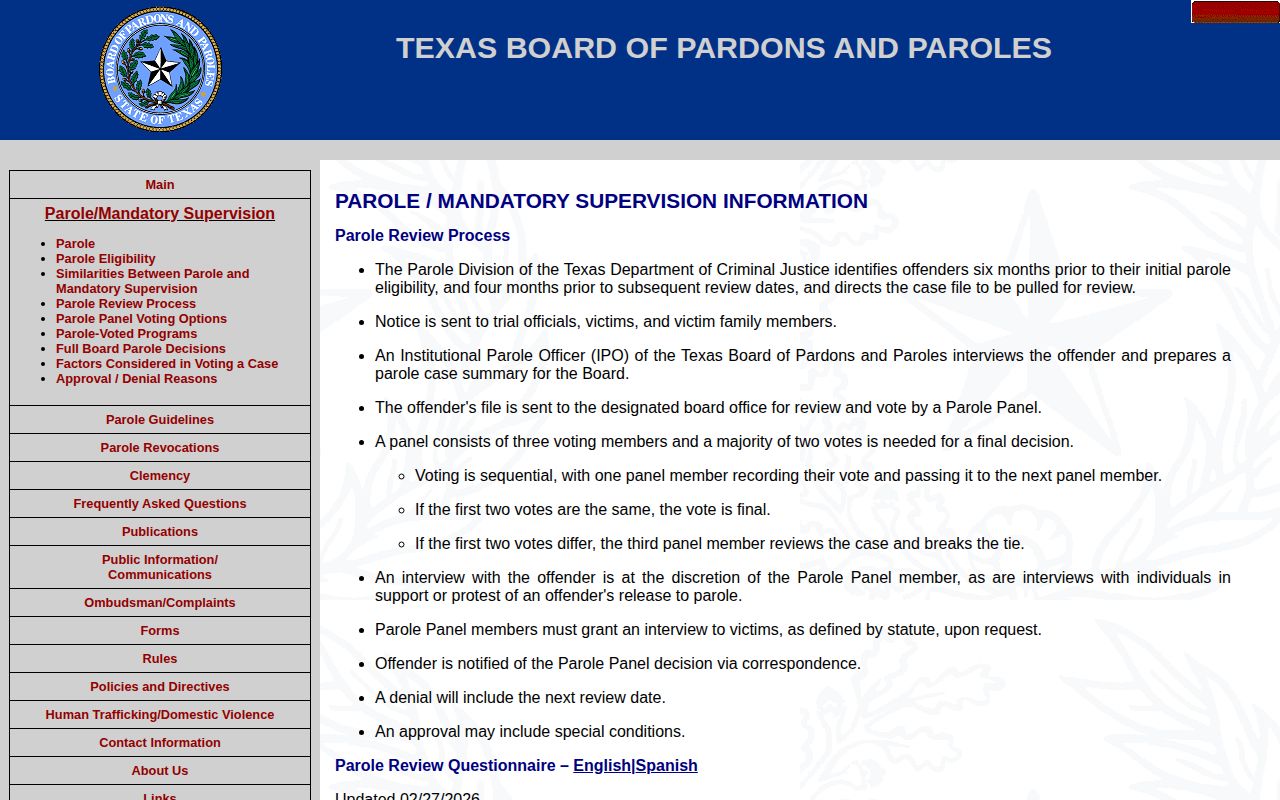
Ordinary Texas parole review is a file vote, not a formal public hearing. An Institutional Parole Officer prepares a summary, and a three-member panel votes in sequence. Two matching votes decide the matter. Review starts before eligibility, but eligibility only opens consideration.
Official vote codes require the Board’s definitions. FI variants can approve release at eligibility or after a set month, program, or transfer. NR is denial with a next review. Other codes address mandatory supervision or serving all. Approval can be withdrawn on new information. General review may take roughly two to six months, but that range does not predict one case. Review preparation normally begins six months before initial eligibility and four months before a later review.
The Board parole-review page is shown below.
Lubbock Parole Eligibility Records
Texas has no blanket rule that every state prisoner must serve 85 percent. Government Code section 498.003 treats good-conduct time as a privilege that affects eligibility for parole or mandatory supervision, not as a reduction of the sentence. Credits may be forfeited. The offense date, sentence, offense category, and findings determine which part of Government Code section 508.145 controls.
For many ordinary cases, calendar time plus good time must reach one-fourth of the sentence or 15 years, whichever is less. Specified serious offenses and deadly-weapon findings generally use a different flat-time threshold, with good time excluded from that minimum. Other offenses have special rules or exclusions. Eligibility should therefore come from TDCJ’s calculation and the controlling judgment, not a homemade formula.
Search Lubbock Release Records
Use a name and stable identifier to begin a purpose-neutral public-record search, then verify the result with the supervising agency or court.
Sponsored Results