
Lubbock County Release Alerts Changed
The familiar VINELink name is now historical for Texas county notifications. Texas moved county victim notification to Texas IVSS-Counties on September 1, 2025. The Texas Attorney General states that existing VINE registrations carried over. Lubbock County had approved the IVSS vendor arrangement, and the Sheriff links the service among its public resources. A person returning to an old VINE workflow should use the Texas portal rather than assume the service ended.
IVSS is designed for people currently in custody or under supervision. Its records can support a current status check and event notice, but the portal warns that someone no longer in custody may be omitted. That makes a post-release search miss weak evidence. A saved alert paired with the Sheriff’s release or transfer document is far stronger. The county jail record identifies the event, date, release code, and any receiving authority that the live notification search may no longer show.
The successful project image comes from Lubbock County’s IVSS vendor action.
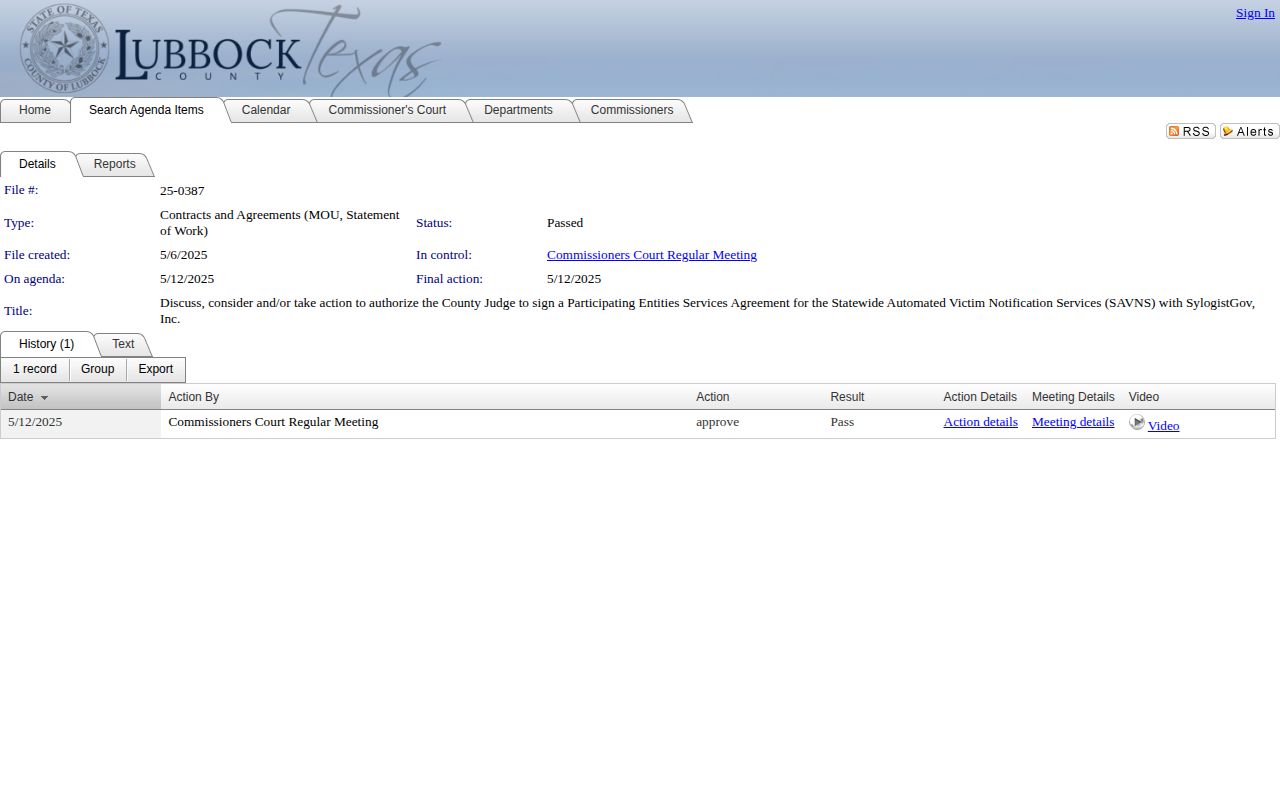
The county action confirms the local layer behind the statewide transition, while the live IVSS portal remains the place to search and register.
Search Lubbock County IVSS Records
Start with enough detail to separate people who share a name. IVSS accepts a full or partial name as well as a DOC ID, SID, Jail ID, or permanent booking number. An agency and identifier match matters more than a name alone. The Lubbock County Detention Center and a TDCJ prison are different custodians, even when both events concern the same person.
- Open Texas IVSS-Counties and enter the most precise identifier available.
- Compare the name, agency, ID, and custody details before opening a result.
- Choose only the record that matches the known jail or state corrections path.
- Save the record reference and the time of the search.
- If no match appears, use the records and court fallbacks instead of declaring release.
For a Lubbock County jail booking, check the official current roster gateway as a second current-custody source. Its interactive, PDF, and Excel options are three formats of the same live roster. They are not an archive. The broader Lubbock County released inmate search explains how the historical release record and court case complete the check after the person drops off the roster.
Lubbock County Notification Fields
The available fields and event choices depend on the record. IVSS can expose enough information to identify the person, locate the participating custodian, and request an alert. It should not be read as a permanent release certificate. Preserve the wording the portal uses, especially where it distinguishes a booking, transfer, release, supervision event, or court update.
| Field or event | How to use it |
|---|---|
| Name and identifier | Match the person by DOC, SID, Jail ID, or permanent booking number. |
| Agency or location | Shows which participating custodian supplied the current record. |
| Custody or supervision status | Describes the portal’s current entry, not a full release history. |
| Booked or released event | May be selected for notice when offered on the matched record. |
| Transfer event | Signals movement to another custodian and must not be called community release. |
| Court, escape, or death event | Additional alert types may appear when supported by the source agency. |
Set Lubbock County Release Notice
A notification request can be made with or without an IVSS account. An account adds useful controls, including history, saved preferences, pauses, blackout hours, and one-time registration management. Migrated users may be prompted to update a password when first entering the new system. Current official instructions do not document the old VINE four-digit phone PIN as part of the present Texas flow.
- Open the correctly matched person and choose the notification request.
- Select an offered event, such as booked, released, transfer, court change, death, or escape.
- Choose phone, text, or email based on the options displayed.
- Complete the live verification steps and save the confirmation.
- Keep contact settings current and review account history after an alert arrives.
People who cannot find the correct record can call IVSS support at 866-268-8959. That call may resolve a registration or match issue, but the Sheriff remains the source for a county booking or release document. Do not substitute a support call for the record.
Note: Legacy VINE used a phone PIN, but current Texas IVSS instructions do not publish that step and it should not be assumed.
Lubbock Release Systems Differ
The correct follow-up depends on custody scope. A person held only at the Lubbock County Detention Center belongs to the Sheriff’s booking and release system. A person received by TDCJ, including someone at John Montford Unit, belongs to the statewide prison and parole system. A federal prisoner belongs to BOP, USMS, and the federal court. Immigration custody belongs to ICE. IVSS does not turn those separate systems into one archive.
| Custody path | Current check | Release proof |
|---|---|---|
| Lubbock County jail | LCSO roster and IVSS | Sheriff release or transfer document and court order |
| TDCJ state prison | TDCJ inmate search and IVSS where supported | TDCJ information, discharge data, or Parole Division record |
| Federal custody | BOP locator or federal docket | BOP record or signed federal order |
| ICE custody | ICE current detainee locator | ICE or immigration-court confirmation |
A transfer can make a person vanish from one source while custody continues elsewhere. Search the receiving system when the county release code or court record points to another authority. Absence alone does not distinguish release, transfer, data delay, sealed material, or a mismatched identifier.
TDCJ Dates Beyond IVSS
The TDCJ offender search supplies the state-prison path. Search with the seven-digit TDCJ number or SID when known, then use exact name and demographic details if needed. TDCJ describes its online tool as current-inmate-only. A former prisoner may disappear from that interface, so it is not a released-person archive.
A current TDCJ detail can show a Projected Release Date. Later processing may add a Scheduled Release Date and Scheduled Release Location. A projection is calculated from the sentence and eligibility rules. A scheduled date follows more release processing, but it still may change. Neither field is the same as the actual release or discharge record. For a former prisoner, send the name and TDCJ number to pia@tdcj.texas.gov, or provide birth information and county of conviction when the number is unknown. TDCJ states that this information route has no charge.
Confirm Lubbock County Release Alerts
For a county jail event, request the existing record from LCSO. The LSO-1064 information form expressly lists Release / Transfer Documentation. Identify the person, date of birth, booking or SID number, case number, and date range. Ask for the release date and time, release type or code, releasing authority, receiving agency, charges, and booking identifier. Request the code definition rather than asking staff to create an explanation.
The same record can be submitted through LCDCRecords@LubbockCounty.gov, fax at (806) 775-7991, mail to P.O. Box 10536, Lubbock, TX 79408, or in person at 712 Broadway. The criminal case adds context. County-court-at-law misdemeanor records go through the County Clerk; felony district-court records go through the District Clerk. A signed bond order, dismissal, judgment, or discharge document can explain why custody changed.
Federal and immigration cases require another pivot. The BOP locator may show “Released” and a date for a former federal prisoner, while USMS pretrial custody may require the federal docket. The ICE locator searches present detention and is not a release archive. In every system, two independent official records provide a safer conclusion than one search result.
Note: A registry applies only to a person with a legal registration duty and cannot replace a jail, TDCJ, or court release record.
Preserve Lubbock Release Evidence
Keep the alert confirmation, message text, delivery time, person identifier, and agency name. Those details help the records custodian locate the matching event. They also show what IVSS reported at that moment. A screen capture without an agency or identifier may be too vague to distinguish two people with the same name.
Then ask for an existing document. The strongest county proof is a release or transfer entry showing the timestamp, type or code, releasing authority, and destination. A signed court order can explain the legal basis. For TDCJ, an agency status entry, release certificate, discharge information, or Parole Division assignment supplies the state context. These records resolve the key uncertainty that an alert alone cannot: whether the person entered the community, transferred to another custodian, or remained under legal supervision.
Timing can create brief conflicts. A roster may refresh, an alert may arrive later, and a court docket may post on another schedule. Record when each source was checked and compare identifiers. If two sources disagree, contact the office that created the underlying custody record instead of choosing the result that seems newest.